 |
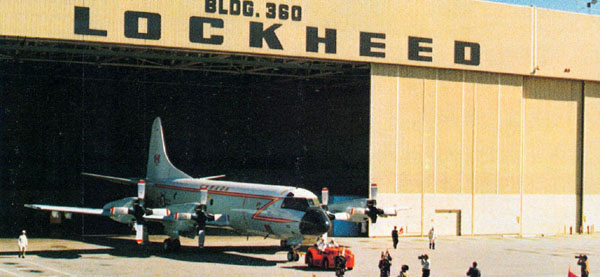
| To the skirl of bagpipes, the first Aurora rolls out of a Lockheed hanger on January 25, 1979. (Photo ID unknown) |
This is a reprint of an article which appeared in the 1979/2 issue of Sentinel Magazine.
|
| To the skirl of bagpipes, the first Aurora rolls out of a Lockheed hanger on January 25, 1979. (Photo ID unknown) |
"I christen this aircraft 'Aurora' , and I trust she will always serve this flag and her country with distinction, And may she bring her crews home safely." The words were delivered with a sense of pride and obvious sincerity by Mrs. Mildred Nixon, wife of C.R. (Buzz) Nixon, deputy minister of the Department of National Defence. Then, taking the Canadian flag she had been handed by Sgt Dave Bamford of the CP-140 training/development team, Mrs. Nixon placed it into the specially-mounted holder on the aircraft's exterior.
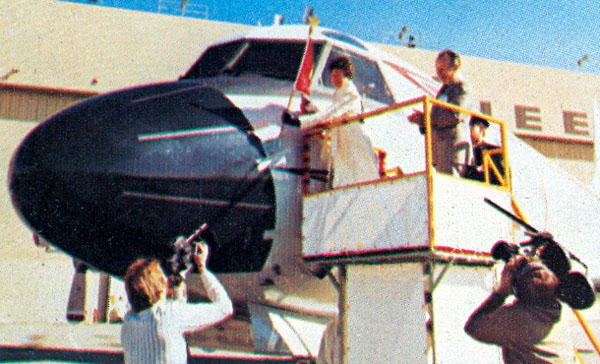 |
| Mrs. Mildred Nixon, wife of the Deputy Minister of National Defence, christens the Aurora (Photo # IXC 79-16) |
It was January 25, and the first of the Canadian military's new fleet of 18 long range ASW patrol planes - aircraft 140101 - had just been ceremoniously "rolled-out" from a hangar at Lockheed's Burbank complex. With two members of the CFB Ottawa Pipe Band - Pipe Major Archie Cairns and MWO Charles Bell - as escorts, and to the strains of the RCAF march past, the CP-140 was making its public debut. As hundreds of assembled guests - Canadian and American - looked on, the aircraft was slowly towed to a position adjacent to one of the planes the new fleet will replace, an Argus from VP407 Squadron, CFB Comox.A taped version of "0 Canada" held the crowd briefly motionless, eyes moved from one plane to the other. The old and the new, long and faithful service rendered; the demands of duty yet to come.
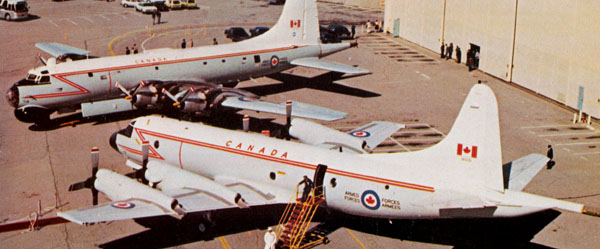 |
| The new Aurora in the foreground with the soon-to-be retired Argus in the background (Photo # IXC 79-19) |
Argus To AuroraThe transition will not happen overnight. And in the interim the intensive planning, co-ordination, testing, training and construction will continue.
Aircraft 140101 will be flight tested for the first time March 22. On this occasion only a Lockheed flight-test team will be on board. The second and third aircraft off the production line will be ready to fly in October of this year and January of next, respectively, and then all three planes will be involved in a flight test program of up to 525 hours.
In addition to officials from lockheed, eight Canadian Forces personnel will take part in the flight test phase; their number including pilots, navigators, flight engineers and observers. This team will remain in Burbank until the last of the CP-140s has been accepted and delivered.
Following the first flight test, at least three Canadians will be on board for subsequent testing and, of the 525 hours set aside, 80 hours have been allotted to the Canadian team, with the first 20 of these hours blocked out for this September. The fourth aircraft off the line will also be ready to fly by January, 1980, and this plane is the one designated for first delivery to Canada. A Canadian military crew will fly it to CFB Greenwood in May, 1980.
The CP-140s will come off the assembly line at a rate of roughly two per month, and by the end of 1980, 13 of the new fleet will have been delivered to Canada, with the remaining five ferried north by the spring of 1981.
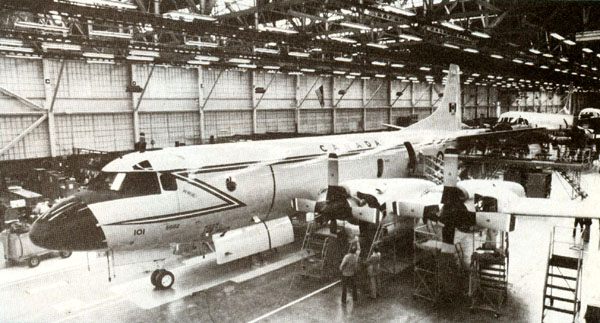 |
| Lockheed assembly line. (Photo ID unknown) |
 |
| The aircraft's interior during assembly. (Photo ID unknown) |
Crew training will begin a few months prior to the delivery of the first aircraft. The intensive courses are scheduled in Burbank for February or March of 1980.In the initial phase, 10 crews will take the courses in three separate groupings. Three crews will then head to California, followed by another group of four and then the final three. The first course will last 16 weeks, and successive courses will be of 10 weeks duration. The courses involve ground training only; flight training will follow at CFB Greenwood.
The fourth course will be held at CFB Greenwood, and by the time it is ready to begin, Canadians already trained will be in a position to assume much of the instructional responsibilities. Lockheed officials will then start to phase out of the program. Canadian military officials expect a nip and tuck struggle to maintain the training program for aircrew and technicians in concert with the delivery schedule. Personnel will likely be working up to 16 hours a day during the turn-over period.
The complexity and sophistication of the new equipment on board the CP-140s requires an equally high level in the realm of ground support facilities. To this end a Ground Support Computer Complex (GSCC) is being established at CFB Greenwood, and will be operational by October, 1980.
The two main components of the GSCC will be the Program Generation Centre (PGC) and a second system with a dual-mode capability - the Integrated Avionics Trainer (IAT) and the Systems Integration Laboratory (SIL). The PGC is that part of the facility which will handle changes to, and the maintenance of computer programs.When the second system is in, its IAT mode will be used to train avionics and maintenance technicians, and "faults" will be deliberately inserted into the equipment for training purposes. In the SIL mode, the second system will be considered fully operational and will be used to validate changes made in programs by the PGC. Economics have determined that a second GSCC will not be located at CFB Comox. What the west coast base will have in common with CFB Greenwood is the Data Interpretation/Analysis Center (DIAC).
DIACs are simply an up-dated version of what crews have known in the past as the "Ops" centre, and it is here that briefings, debriefings, flight planning and analysis and meteorological information will be handled.
The DIAC at CFB Greenwood will be somewhat more sophisticated and comprehensive than that at CFB Comox. The latter could best be considered a mini-DIAC. The centre at Greenwood will be operational by November, 1980 and the one at Comox by March, 1981.Other support systems at CFB Greenwood for the CP-140s will include the flight deck and operational mission simulators, ready for use by April, 1980, and six maintenance trainers being delivered to the base late this year or early in 1980.
The 26 months from roll-out of the first CP-140 to delivery of the 18th will be marked by frenzied activity as military personnel work to integrate all systems - airborne and land-based. Sometime in 1981 the culmination of all their efforts will signal a new era in maritime ASW - the dawn of Aurora.
(Jo Ann Gosselin is an Ottawa-based freelance writer, specializing in military affairs.)
GOODBYE SPIT and GLUE
HELLO INTERFACING WIDGETSFrom Sentinel Magazine 1979/2, page 20.
(The article has no author listed)Tracing the development of the new aircraft maintenance training program for Aurora technicians is somewhat akin to wading through alphabet soup. Acronyms and less pronounceable short forms for equipment and plans swirl by in a fog of unfamiliarity. For the technicians who will maintain the new maritime long range patrol aircraft, the fog is scheduled to lift over the next two years.
The first Aurora will arrive in Canada in May, 1980. In January of that year, 80 carefully selected technicians are to begin the first CP-140 aircraft maintenance training course. By the end of March, 1981, some 900 technicians will be working on the 18 aircraft scheduled for delivery.
To say the Aurora represents a new era in maintenance training is a mild understatement. Ten onboard digital computers, as well as computerized test equipment, operational support equipment and flight and mission training simulators will challenge the expertise of technicians. Over 50 per cent of the maintainers, the avionics techs, the weapons techs, instrument-electrical techs, and even the photo techs will work with computers on a regular basis.
Maintenance training standards came up for discussion early during contract talks with the Lockheed Company. As negotiations progressed, a maintenance training plan began to evolve. Under the plan, Lockheed was to assume overall responsibility for developing and revising courses to meet Forces' standards. A development team made up of 50-odd CF technicians would work with Lockheed on the project.
 |
| Canadian Forces personnel and Lockheed staff discuss Aurora training schedules. Left to right are Frank Simmons, Capt Hugh Tamblyn, Maj Gus Armstrong and Ray McCaslin. (Photo ID unknown) |
When the dust finally settled after the negotiations, the maintenance plan stood intact. Lockheed swung into action immediately, dispatching senior training management officers to CFBs Comox, Greenwood and Borden to observe the Forces' current maintenance operations and training methods. Meanwhile, an appraisal team arrived at Lockheed's plant in Burbank from CFB Trenton, to advise on the maintenance plans being created for the Aurora hardware.Such detailed planning had one main aim - to reduce shortfalls in subsequent maintenance training. In the past it has taken as long as half an aircraft's life to mold a training package to meet the maintainer's original requirements. Historically, instructors at the field training technical units (first stop for novice technicians) have been trained by the contractor introducing a new aircraft. Just how relevant that initial training was depended a great deal on the quality of the contractor's course.
Well ahead of delivery, Lockheed has set up an instructors' course for their own personnel, subcontractors and CF technicians. All courses will be taught initially in Burbank. Subsequent courses will be held at Greenwood. In fact, between January 1980 and April 1981, courses will be conducted at Greenwood on a two-shift basis to meet the demanding aircraft delivery schedule.
A new building under construction at Greenwood will accommodate aircrew and maintenance training. When completed, the building will house 20 classrooms as well as avionics, engine, ordnance/photo, electrical systems, surface control, automatic flight control and propeller synchrophaser trainers. Most important to maintenance technicians will be the integrated avionics trainer, which contains all avionics systems positioned much the same as they will be onboard the aircraft.
The dawn of Aurora is indeed the dawn of a new maintenance system for technicians.
Credits and References:
1) Sentinel Magazine 1979/2, page 8.