
CATWALKS
CATWALKS
 |
This is one of two catwalks that were installed on the ship during the refit of October 1944. Due to the 'split deck' configuration, Tribals were considered to be 'wet'. In periods of rough seas or heavy weather, the deck would be awash with water. The inclusion of the catwalks connecting one deck (the foc'sle) with the After Canopy made fore and aft movement much easier and safer in heavy weather. Seen here is the starboard catwalk.
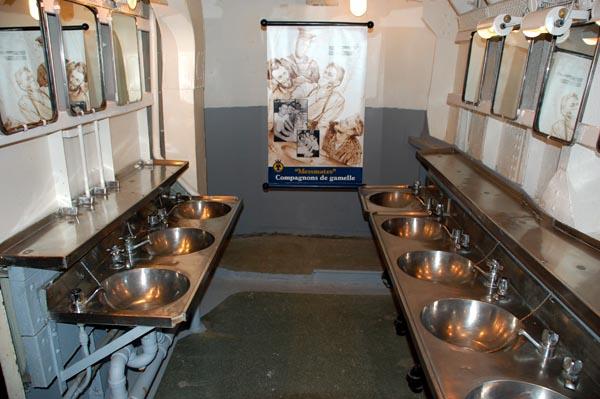 |
| Wash basin area and shower stall off the port side passageway, mid-ship. Water for washing was drawn from the fresh water tanks then replenished from the evaporator when HAIDA was at sea. (Photo by Jerry Proc) |
MOTOR CUTTER
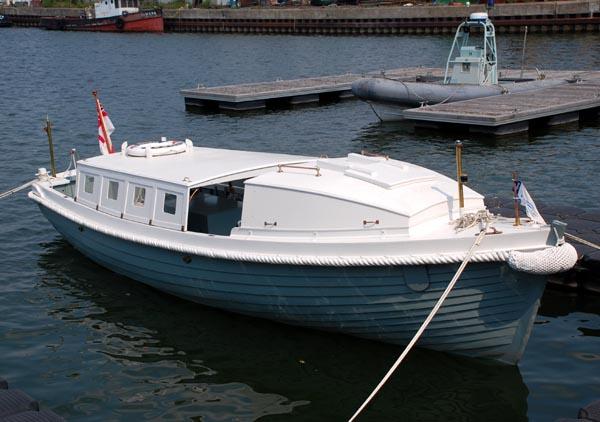 |
| HAIDA's motor cutter was restored and made seaworthy in 2007. Due to problems which developed after the restoration, the cutter was placed on permanent display in HAIDA's Gift Shop. Select this link for the complete story. (Photo by Jerry Proc) |
 |
| Engineering Officer's Cabin: All the engineering drawings for the ship were located in this area which doubled as an office and living quarters for the Engineering Officer. By 1950 all destroyer escorts had an Electrical Officer. He was responsible for all things electrical and electronic and thus had custody of the electrical drawings. The drawings were not stored in the Electrical Officer's cabin, but could have been held in the Electrical Workshop, with electronic (radar, comm, etc) drawings held in the Electronics Maintenance Room (EMR). |
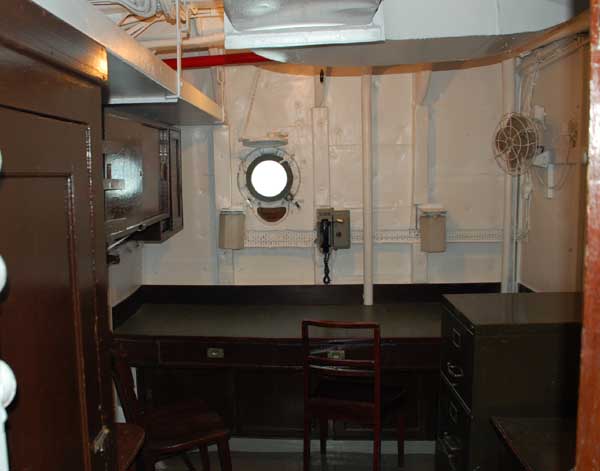 |
| Coxswain's (Regulating) office: As the senior non-commissioned officer, the Coxswain worked closely with the Captain on the administration of the ship and crew. Mail was also sorted and sent from this office. |
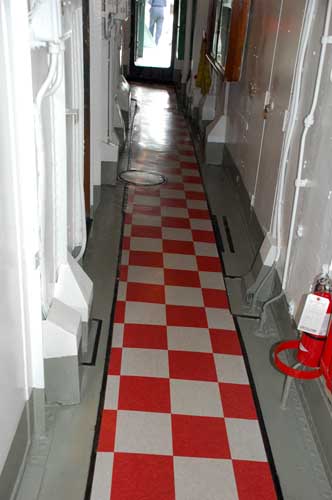 |
| In the forward port and starboard passageways, the existing 12" x 12" tiles were removed and replaced with period (Korean war era) 9"x 9" tiles. Since this format of tile is no longer available, 12" x 12" tiles were purchased and then pruned from 12"x 12 " to 9"x 9" size at the shop of the tile layer. The same colour pattern was used in the forward mess areas and the passageways were also repainted. The aft passageway also received the same treatment but a green/gray pattern was used. |
|
|
ENGINEERING WORKSHOP
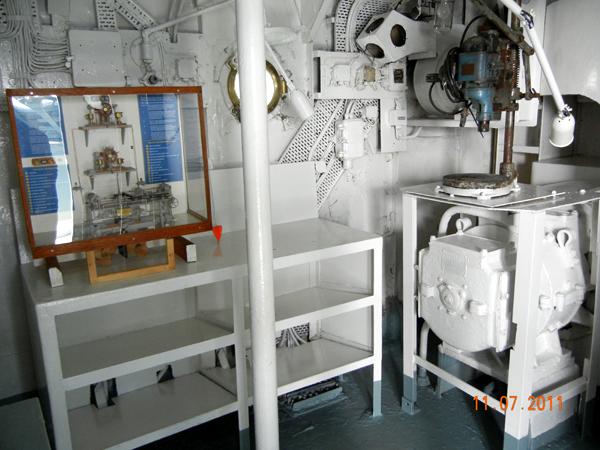 |
| The Engineering Workshop was repainted by HAIDA's volunteer Stoker, Marg Mathers in 2011. At the left side is a model to illustrate the operation of the tiller motor, associated hydraulics and controls. It was built by Marg Mathers and Jim Brewer. (Photo by Jim Brewer) |
WEAPONS WORKSHOP
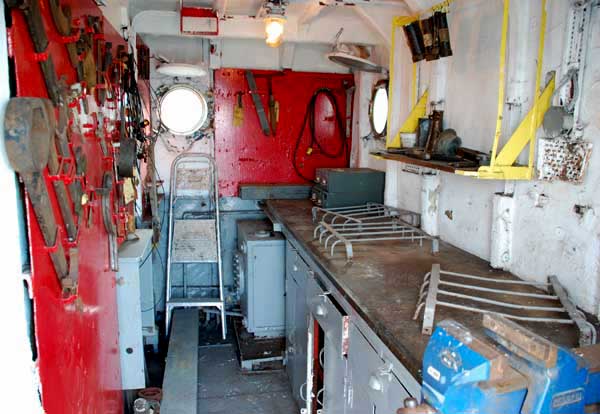 |
| Weapons technicians stored their tools here and carried out minor repairs. Guns crews also used this as a shelter. (Photo by Jerry Proc) |
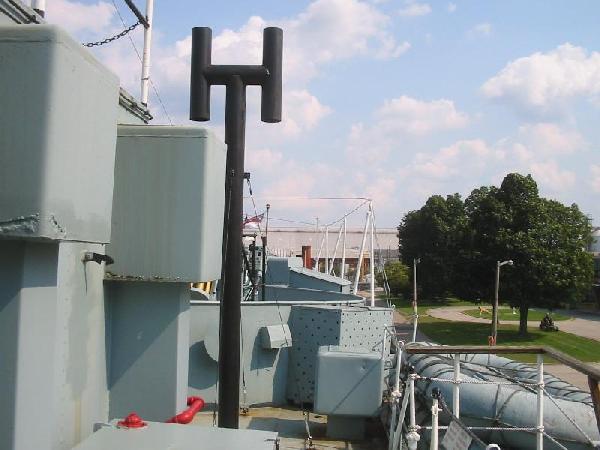 |
| The exhaust stack for the stove in the Officer's Galley was known as the "Charlie Nobel" and was restored in 2006. Around 1850, a British merchant service captain, Charles Noble, upon discovering that the stack of his ship's galley was made of copper, ordered that it be kept bright. From then onwards, the ship's crew started referring to the galley smokestack as the "Charlie Noble". (Photo by Jim Brewer) |
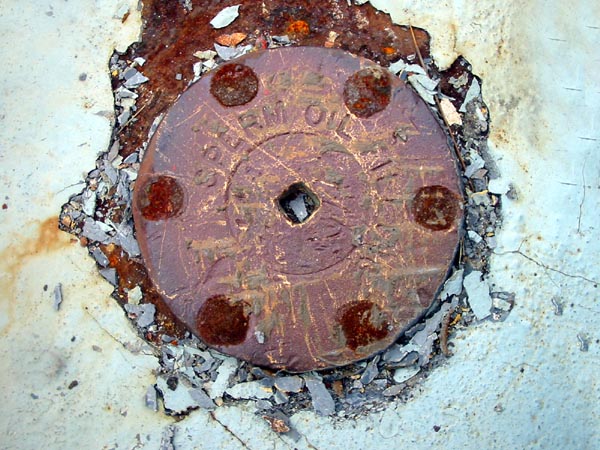 |
| HAIDA's port and starboard running lights were electrically
powered. In case of a major power failure, provision was made to illuminate
these lights using oil lamps. The storage tank for the oil was located
in what was then called "Lamp and Oil Stores". Today that compartment
is called "Paint and Lamp Stores". The filler cap for the oil tank
was discovered around 2007 after being hidden from view under successive
layers of paint. The filler port was located on the upper deck, port side,
ahead of the break in the fo'c'sle.
In spite of the cap being embossed as "Sperm Oil Fill" , the RCN used kerosene as the fuel for the oil lamps. In Britain, that fuel was called Paraffin. (Photo by Jerry Proc) |
Oct 10/11